The Central Provident Fund (CPF) is Singapore’s mandatory social security savings system. For most Singapore Citizens and Permanent Residents, CPF contributions from both the employee and employer help build savings for housing, healthcare and retirement.
CPF can look complicated at first because the money is split across different accounts and the rules change as you get older. This guide covers the main concepts you should understand.
Last updated: 9 September 2026. CPF rules, interest rates and retirement sums can change over time, so always check the latest information from CPF Board before making a major financial decision.
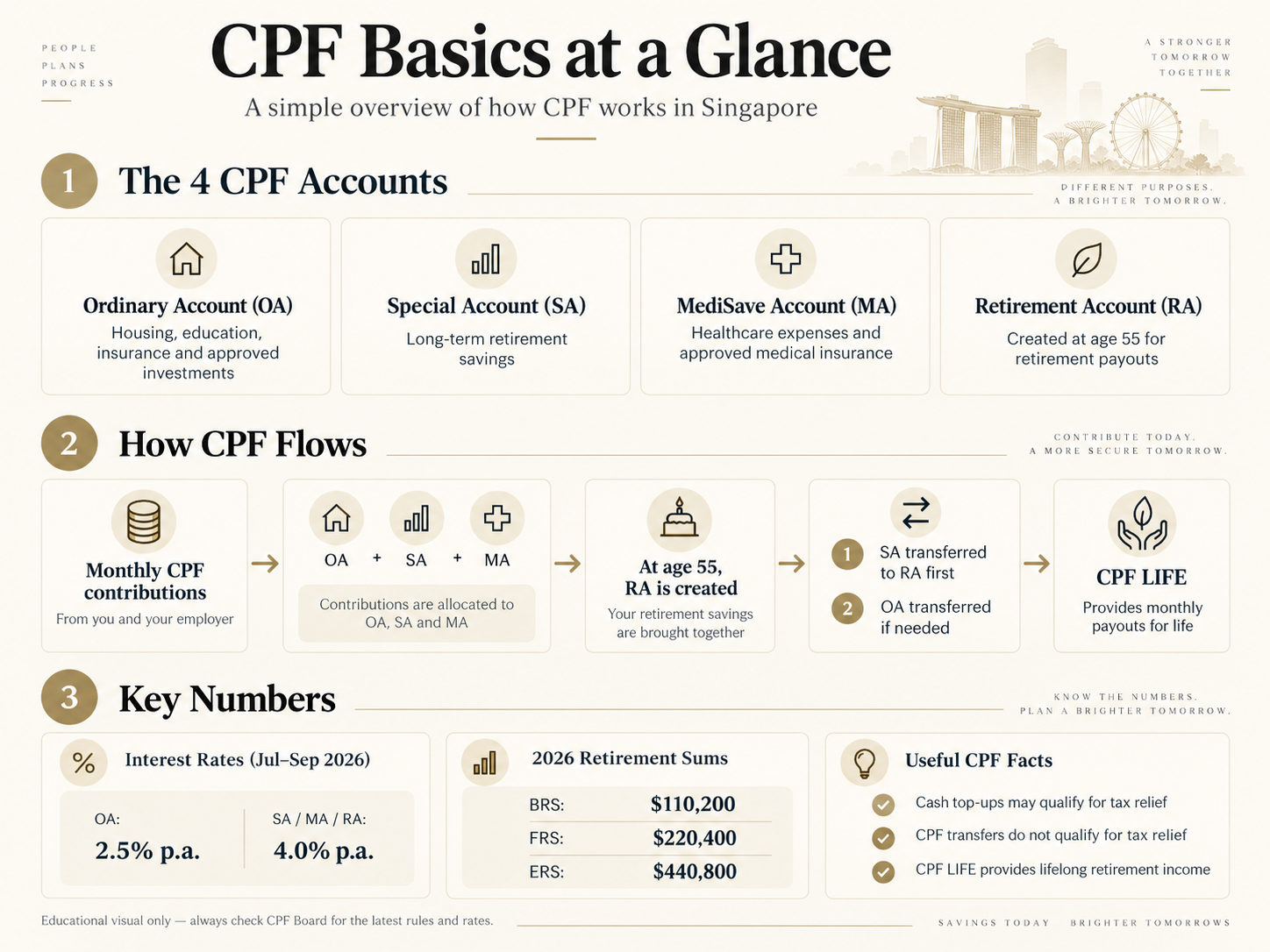
The CPF Accounts
For members below age 55, CPF savings are mainly held in three accounts:
| Account | Main Purpose |
|---|---|
| Ordinary Account (OA) | Housing, approved investments, insurance and education |
| Special Account (SA) | Long-term retirement savings |
| MediSave Account (MA) | Healthcare expenses and approved medical insurance |
At age 55, a Retirement Account (RA) is created.
Savings from your SA are transferred to your RA first, followed by OA savings if needed, up to the applicable Full Retirement Sum. After this transfer, the SA is closed and any remaining SA savings are transferred to the OA.
This is an important change from older CPF explanations that showed the SA continuing after age 55.
CPF Interest Rates
For 1 July to 30 September 2026, the base CPF interest rates are:
| Account | Base Interest Rate |
|---|---|
| Ordinary Account (OA) | 2.5% p.a. |
| Special Account (SA) | 4.0% p.a. |
| MediSave Account (MA) | 4.0% p.a. |
| Retirement Account (RA) | 4.0% p.a. |
The 4% floor rate for SA, MA and RA savings has been extended through 31 December 2026.
Extra CPF Interest
CPF also pays extra interest on part of your combined balances.
Below age 55:
- Extra 1% p.a. on the first $60,000 of combined CPF balances
- The amount of OA savings counted toward this first $60,000 is capped at $20,000
Age 55 and above:
- Extra 2% p.a. on the first $30,000 of combined balances
- Extra 1% p.a. on the next $30,000
- The OA portion counted remains capped at $20,000
This is why CPF can provide relatively attractive low-risk compounding, particularly for retirement balances.
CPF Transfers vs Cash Top-Ups
There are two different ideas that are easy to mix up.
1. CPF Transfers
If you are below 55 and do not need part of your OA savings for housing or other OA uses, you may transfer OA savings to your SA.
For members aged 55 and above, OA savings can instead be transferred to the RA.
The attraction is simple:
- OA base interest: 2.5%
- SA/RA base interest: 4.0%
However, CPF transfers do not qualify for tax relief. They also reduce the amount of money available in your OA, so liquidity and future housing needs should be considered first.
2. Cash Top-Ups
Cash top-ups to eligible SA or RA balances can qualify for tax relief.
You may receive up to:
- $8,000 of tax relief per year for eligible cash top-ups to your own SA/RA
- Another $8,000 per year for eligible cash top-ups to loved ones’ SA/RA
This means the potential relief can be up to $16,000 per year, subject to CPF’s conditions.
Important points:
- Only qualifying cash top-ups, not CPF transfers, receive this tax relief.
- Relief is generally granted only for top-ups up to the applicable Full Retirement Sum.
- The $8,000 self cap and $8,000 loved-ones cap are shared with qualifying MediSave cash top-ups.
- Singapore’s overall personal income tax relief cap of $80,000 per year still applies.
- Additional conditions apply for some family members and matched-savings schemes.
How CPF Tax Relief Actually Saves You Money
A tax relief does not mean the Government gives you the full amount of the top-up back.
Instead, the qualifying top-up reduces your chargeable income.
For example, assume your chargeable income before the top-up is $60,000 and you make an eligible $8,000 CPF cash top-up.
Your chargeable income would fall to:
$60,000 - $8,000 = $52,000
Using the current resident income tax rates, tax on $60,000 is approximately $1,950, while tax on $52,000 is approximately $1,390.
That is about $560 in tax savings from the $8,000 relief.
The important concept is:
The higher your marginal income tax rate, the more valuable each dollar of tax relief generally becomes.
This is one reason CPF cash top-ups may become more attractive as your income rises.
CPF Retirement Sums
When planning for retirement, CPF uses three retirement sum reference points:
Basic Retirement Sum (BRS)
The BRS is designed around basic living needs in retirement, excluding rental expenses.
For someone turning 55 in 2026:
- BRS: $110,200
- Estimated CPF LIFE Standard Plan payout from age 65: about $950/month
Property-related conditions apply if you want to withdraw RA savings down to the BRS.
Full Retirement Sum (FRS)
The FRS is twice the BRS and is the default retirement sum reference point.
For someone turning 55 in 2026:
- FRS: $220,400
- Estimated CPF LIFE Standard Plan payout from age 65: about $1,780/month
Enhanced Retirement Sum (ERS)
The ERS allows members aged 55 and above to voluntarily commit more savings to the RA for higher lifelong payouts.
The 2026 ERS is $440,800, which is twice the 2026 FRS.
For a member turning 55 in 2026 who tops up to the ERS:
- ERS: $440,800
- Estimated CPF LIFE Standard Plan payout from age 65: about $3,440/month
The ERS increases over time. Unlike the BRS and FRS, which are tied to the year you turn 55, the maximum ERS top-up limit is based on the current year’s ERS.
What Is CPF LIFE?
CPF LIFE “Lifelong Income For the Elderly” is Singapore’s national longevity insurance annuity scheme.
Its purpose is to provide monthly payouts for as long as you live, rather than simply letting you draw down a fixed pool of retirement savings until it runs out.
Your eventual payout depends on factors including:
- Your RA balance
- The CPF LIFE plan you choose
- The age you start payouts
- CPF interest rates
- Mortality and life-expectancy assumptions
Monthly payouts can generally begin from age 65. You may defer the start of payouts, and CPF states that payouts can increase by up to 7% for each year of deferment, up to age 70.
The 3 CPF LIFE Plans
Standard Plan
- Provides steady monthly payouts for life (Lower Bequest)
- Starts higher than the Escalating Plan
- Does not increase each year, so inflation gradually reduces its purchasing power
Escalating Plan
- Starts with a lower monthly payout
- Payout increases by 2% every year for life
- Designed to provide more protection against rising living costs
Basic Plan
- Starts with lower payouts than the Standard Plan
- Most RA savings remain in the RA initially (Higher Bequest)
- Payouts eventually decrease when combined CPF balances fall below $60,000
All three plans provide payouts for life.
Why CPF Matters
CPF is not designed to maximise investment returns.
Its main strengths are:
- Government-backed CPF savings
- Predictable interest rates
- Automatic retirement accumulation
- Housing and healthcare support
- Lifelong retirement income through CPF LIFE
- Potential tax relief through qualifying cash top-ups
Its main trade-off is liquidity. Money committed to retirement accounts is intended for long-term needs and generally cannot be treated like normal cash savings.
Key Takeaways
- CPF is the foundation of Singapore’s retirement system.
- OA, SA and MA serve different purposes before age 55.
- At 55, the RA is created and the SA is closed.
- OA currently earns 2.5% p.a., while SA, MA and RA currently earn 4.0% p.a.
- Cash top-ups may provide tax relief; CPF transfers do not.
- BRS, FRS and ERS are retirement planning reference points that influence future payouts.
- CPF LIFE converts retirement savings into lifelong monthly income.
If you want to understand where CPF fits compared with the Supplementary Retirement Scheme, read CPF vs SRS: What’s the Difference?.
Official Sources
- CPF Board — CPF interest rates
- CPF Board — Retirement sums
- CPF Board — CPF LIFE
- CPF Board — Cash top-ups and tax relief
- IRAS — Individual income tax rates
This article is for educational purposes only and is not financial or tax advice.